AI-Driven Multilingual Video Production Pipeline
Business Challenge
Producing long-form documentary videos for a network of YouTube channels in multiple languages involved many repeated steps: research, scripts, voice-over, footage, editing, covers, metadata, and scheduled upload.
More than ten projects ran at the same time and shared one generative video account with fixed request limits. Manual coordination was slow, and a failed step could stop a video halfway or repeat paid generation.
My Role
I designed the production process, assigned tasks to LLM agents and contractors, reviewed and accepted the results, and managed parallel work across projects.
Approach
- Built a single production pipeline and adapted copies of it for each language and channel instead of separate tools.
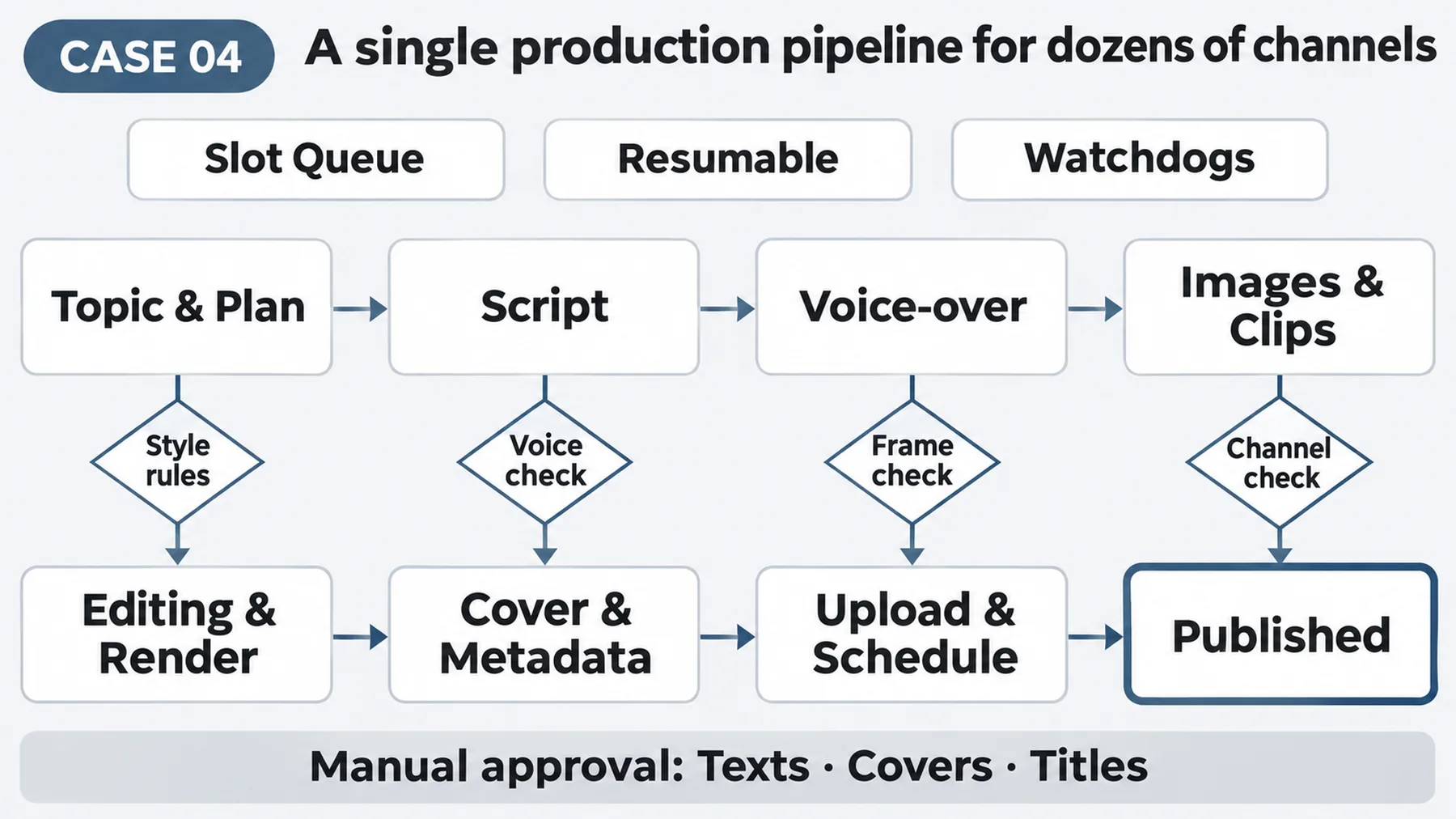
- Divided production into stages: topic and plan, script, voice-over (text-to-speech), images and video clips (generative video), editing and rendering (ffmpeg), covers, metadata, upload and scheduling.
- Added a control point between stages:
- scripts are checked against style rules and an acceptance checklist;
- voice-over is transcribed and compared with the script text;
- generated clips pass an automated check for defective frames;
- before upload, the channel ID and schedule are verified.
- Introduced a shared slot queue, so projects take turns within the account limits instead of competing.
- Set up watchdogs: scheduled tasks that detect stopped processes and restart them.
- Made pipelines resumable: completed steps are recorded, so a restarted process continues where it stopped without ordering paid generation again.
Examples
Example A — Portuguese documentary channels. Three channels ran on a single production pipeline instead of three separate setups, with every film passing the same script, voice-over and clip checks. On one channel, the first six videos gathered about 102,000 views in their first four days (Aug 31 – Sep 3, 2026), with the top two at 41,000 and 40,000. Another channel, with 213 subscribers, reached about 20,000 unique viewers in 28 days.
Example B — Spanish maritime history channel. The channel published 69 videos, including about 35 films of 27–34 minutes, and reached 285,149 views in about three months (YouTube Studio, Oct 7, 2026). Subscribers grew from 734 to 1,030 in one week (Sep 30 – Oct 6). Its best-performing film drew 868,000 impressions at a 5.99% click-through rate; top films reached 6.5–6.6% against a channel median of 3.6%. 62% of impressions came from the YouTube home page, and 90% of views came from subscribers.
Outcome
Within three months (Aug–Nov 2026), the pipeline supported production for a network of dozens of channels in multiple languages. Hundreds of long-form videos were produced and uploaded to YouTube; short clips were also scheduled on TikTok.
On the channels with available analytics, the videos gathered hundreds of thousands of views. The best-performing film reached 191,550 views in 18 days after its Sep 19 release, and the strongest 30-minute films held an average view of 43–44% (12–14 minutes out of 28–32).
Routine steps became automated. Manual work was limited to editorial decisions: approval of cover images, titles, and part of the texts.